Mechanical Seal Types: Single, Double, Cartridge and Bellows Compared
In most centrifugal pumps, the most vulnerable point is neither the impeller nor the motor: it is where the shaft passes through the casing. That is where a part turning at 1,450 or 2,900 rpm meets a pressurised liquid that wants to get out. The mechanical seal is the component that resolves that conflict — and also the one that most often forces a pump to stop.
When the liquid is an acid, an alkali or a toxic product, the choice of seal stops being a catalogue detail. A seal leak means corrosion on the baseplate, fumes in the building, product in the bund and, in the worst case, a risk to people. Choosing the right seal type, materials and arrangement matters as much as choosing the pump material.
In this guide we explain how a mechanical seal works, what its components are, what materials such as silicon carbide bring, how the main mechanical seal types — single, double, cartridge seal and bellows seal — differ, and how to decide which one suits each application.
What a mechanical seal is and how it works
The sealing principle: two flat faces and a film of liquid
A mechanical seal works by means of two rings with flat faces running against each other. One of them turns with the shaft; the other is fixed in the casing or in the seal gland. An elastic element — one or more springs, or a bellows — keeps both faces in contact with a controlled force, to which the pressure of the liquid itself is added.
The faces are machined and lapped to a flatness of fractions of a micron. Between them an extremely thin film of liquid forms, which lubricates and cools them. That film is essential: a mechanical seal is not designed to run dry, and without it the faces overheat, crack or wear out in a very short time.
The result is not absolute containment, but a controlled leakage so small that it normally evaporates without ever being seen. With harmless liquids that is irrelevant; with toxic or volatile products, or ones that crystallise on contact with air, that minimal leakage is precisely what makes double arrangements or sealless pumps necessary.
Compared with traditional gland packing, which seals through the friction of braided packing compressed against the shaft and needs to drip to keep cool, the mechanical seal drastically reduces leakage, does not wear the shaft and uses less energy. That is why it is now the standard solution in process pumps.
Mechanical seal components
Although designs vary widely, all mechanical seals share the same functional elements:
| Component | Function | Usual materials |
|---|---|---|
| Rotating face | Turns with the shaft and forms one of the two sealing surfaces | Silicon carbide, carbon-graphite, tungsten carbide |
| Stationary face (seat) | Remains fixed and forms the other sealing surface | Silicon carbide, ceramic, carbon-graphite |
| Secondary seals | Seal between each face and the part that holds it (shaft, sleeve or casing) | FKM, EPDM, FFKM, PTFE or encapsulated O-rings |
| Loading element | Keeps the faces in contact and compensates for wear | Single spring, multiple springs or bellows (metal, elastomer or PTFE) |
| Drive and retaining parts | Transmit rotation to the rotating face and hold the assembly together | Stainless steel, resistant alloys or engineering plastics |
| Seal gland or cover | Houses the stationary face and closes the seal chamber | Material compatible with the fluid; in plastic pumps, thermoplastic |
In a thermoplastic pump, the design must also deal with a detail that goes unnoticed in metal pumps: plastic cannot take the same stresses as metal. If the seal seat is clamped directly against the casing, the casing may deform over time and open a leak path. That is why well-designed pumps seat the seal without transmitting stress to the plastic body and protect the metal shaft with a thermoplastic sleeve.
Face materials: silicon carbide, carbon, ceramic and PTFE
The pair of face materials largely determines the life of the seal. Each combination strikes a different balance between hardness, chemical resistance, thermal conductivity and tolerance of adverse conditions:
| Material | Advantages | Limitations | Typical use |
|---|---|---|---|
| Sintered silicon carbide (SSiC) | Very hard, good thermal conductor, no free silicon: resists strong acids and alkalis | Brittle under impact; little tolerance of dry running in hard/hard pairs | Corrosive and abrasive fluids; SiC/SiC pair with solids |
| Reaction-bonded silicon carbide | Hard and more economical | Contains free silicon, which is attacked by strong alkalis and hydrofluoric acid | Chemically mild fluids |
| Carbon-graphite | Self-lubricating; copes better with start-ups and brief loss of film | Soft; unsuitable for abrasives; limited with strong oxidisers | Carbon/SiC pair in clean liquids |
| Ceramic (alumina) | Good general chemical resistance and low cost | Sensitive to thermal shock; attacked by hydrofluoric acid and hot alkalis | Seats on moderate duties, often against PTFE |
| Tungsten carbide | Very tough and wear-resistant | The metal binder is attacked by many acids | Abrasive, mildly corrosive duties |
| Filled PTFE | Practically inert to any chemical | Soft; limited in pressure, speed and abrasion | Very aggressive, clean fluids, against ceramic |
The practical rule is simple. With clean liquids, the carbon/silicon carbide pair is the most forgiving; with suspended solids, switch to hard faces, typically silicon carbide against silicon carbide, because carbon would be scored. And with chemically aggressive fluids, specify sintered silicon carbide, which contains no free silicon, rather than the reaction-bonded grade.
Secondary seals are chosen with the same logic. FKM resists most mineral acids well, but not hot alkalis, amines or ketones; EPDM works well with alkalis, hot water and steam, but not with oils or hydrocarbons; FFKM offers almost universal resistance at a high cost; and PTFE is inert but not very elastic, so it is used in bellows, in encapsulated O-rings or combined with other elements.
Mechanical seal types
Single seals: internal or external
The single mechanical seal has one pair of faces and is the most common configuration. It is suitable for fluids that are not hazardous, that lubricate the faces well and whose minimal controlled leakage is acceptable. Among single seals, the most important distinction in chemical pumping is where it is mounted:
In both cases, the seal depends on the film of liquid between the faces. Anything that disturbs it — cavitation, air in the suction, vibration or dry running — shortens its life. As we explain in our guide to pump cavitation, the vibration generated by a cavitating pump is one of the most frequent causes of premature seal failure.
Double seals: when you need a second barrier
A double mechanical seal has two pairs of faces in series, with an intermediate space filled with a clean, compatible fluid. The inner seal works against the product and the outer seal against that auxiliary fluid, so the product never reaches the atmosphere directly. There are two main families, covered by API 682 (ISO 21049):
A double seal also solves problems that have nothing to do with toxicity: fluids that crystallise on contact with air, such as concentrated caustic soda, products with solids that would damage a single seal, or liquids that lubricate the faces poorly.
The trade-off is complexity: it needs an auxiliary system for the intermediate fluid, with its own reservoir, instrumentation and maintenance. We will cover the detailed criteria for specifying it, and barrier fluid systems, in a dedicated article.
Cartridge, component and bellows seals
As well as single or double, a seal is classified by its construction. These distinctions come up again and again in specifications:
| Type | What it is | Advantages | When to choose it |
|---|---|---|---|
| Component seal | The parts are fitted to the pump one by one | More economical; takes up less space | Standard pumps with experienced maintenance staff |
| Cartridge seal | Complete seal pre-assembled on its sleeve and gland, factory-set | Quick fitting, no measurements; fewer installation errors | Plants that prioritise reliability and quick replacement; double seals |
| Spring (pusher) seal | One or more springs push the face; the secondary seal slides along the shaft | Versatile, robust design | General use |
| Bellows seal | A bellows acts as both spring and secondary seal | No sliding O-ring that can hang up; in PTFE, highly chemically resistant | Corrosive, crystallising or fouling fluids |
| Balanced / unbalanced | The geometry does or does not reduce the effect of pressure on the faces | A balanced seal withstands higher pressures with less heat | Balanced from moderate pressures upwards or with poorly lubricating fluids |
The cartridge seal deserves a special mention. Many seal failures originate during fitting: a wrongly measured compression setting, a face scratched on insertion or a pinched O-ring. Because it arrives factory-set, a cartridge seal eliminates most of those errors and turns replacement into a job of minutes. Its initial cost is higher, but this is usually offset by fewer stoppages and less wasted spares.
The bellows seal is just as relevant in chemical service. In a pusher seal, the dynamic O-ring has to slide along the shaft or sleeve as the faces wear; if crystals or deposits build up there, it can hang up and the faces open. A bellows seal removes that weak point, because the bellows itself provides the flexibility and the static seal.
PTFE bellows offer practically universal chemical resistance and are the usual solution for external seals on plastic pumps, within moderate limits of pressure and temperature; elastomer bellows are an economical option for water and general services; and welded metal bellows are reserved for high temperatures, where elastomers cannot go.
When to use each type of mechanical seal
Selecting the mechanical seal for the fluid and the application
Selection starts with the fluid and the consequences of a leak. This table summarises the most common recommendations as a starting point:
| Fluid or condition | Recommended arrangement | Indicative faces | Comment |
|---|---|---|---|
| Clean, non-hazardous liquid | Internal single seal | Carbon / SiC | The simplest and most economical option |
| Aggressive acid or alkali, clean | External single seal with PTFE bellows, or internal with compatible materials | Sintered SiC or PTFE / ceramic | No metal parts in contact with the product |
| Liquid with suspended solids | Single seal with hard faces or double seal | SiC / SiC | Avoid carbon; consider a seal flush |
| Product that crystallises in air | Double seal or single seal with quench | SiC / SiC | The auxiliary fluid prevents crystals forming on the faces |
| Toxic, volatile or very valuable product | Pressurised double seal | SiC / SiC or carbon / SiC | Or a sealless pump |
| ATEX zone | According to the risk assessment; frequently double | According to the fluid | Avoid dry running and face overheating |
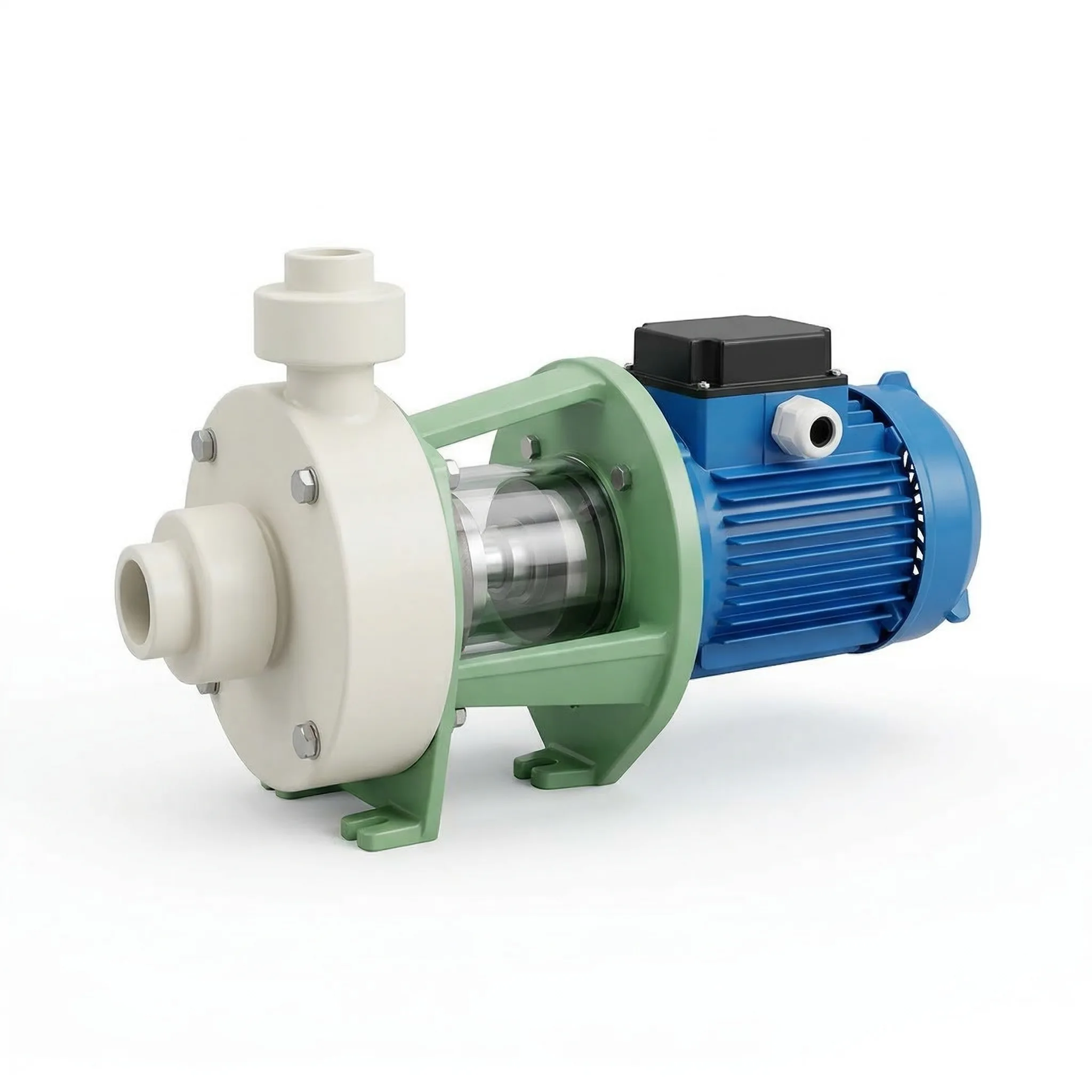
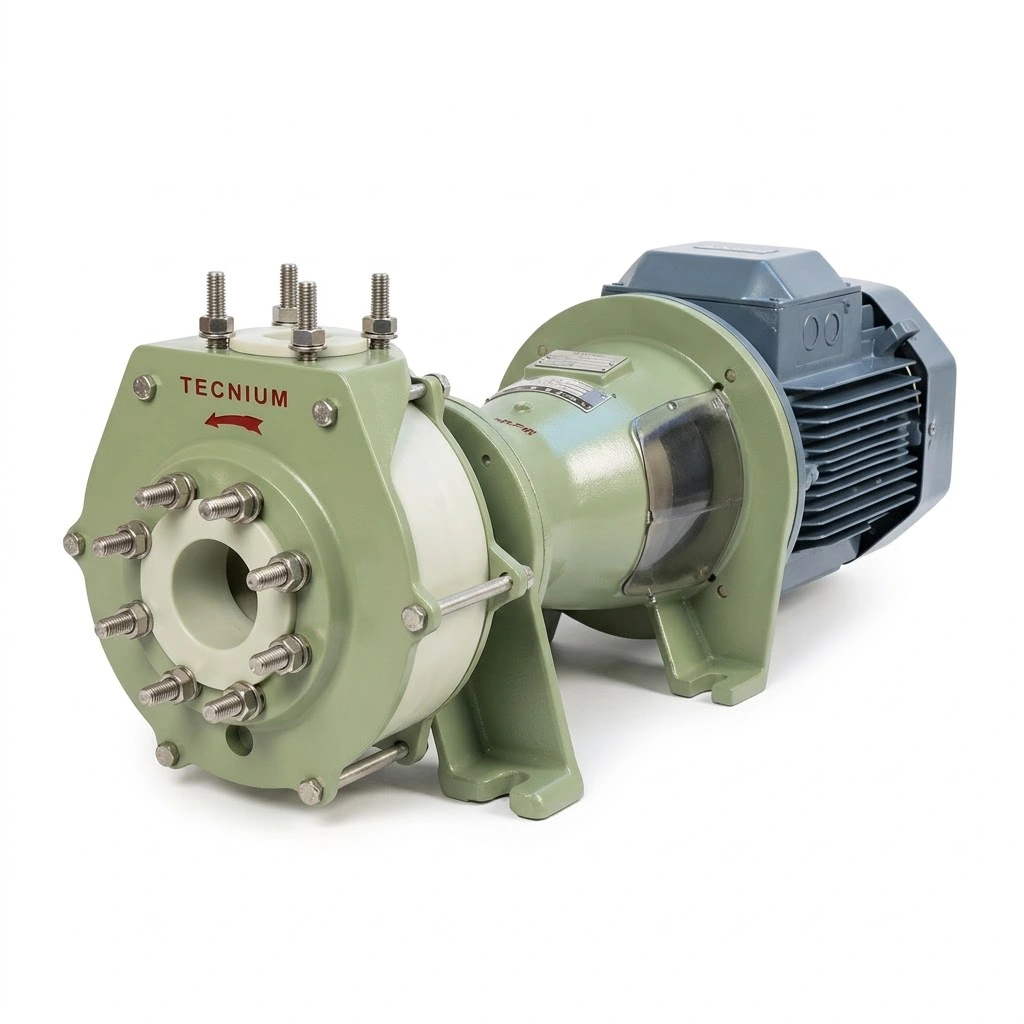
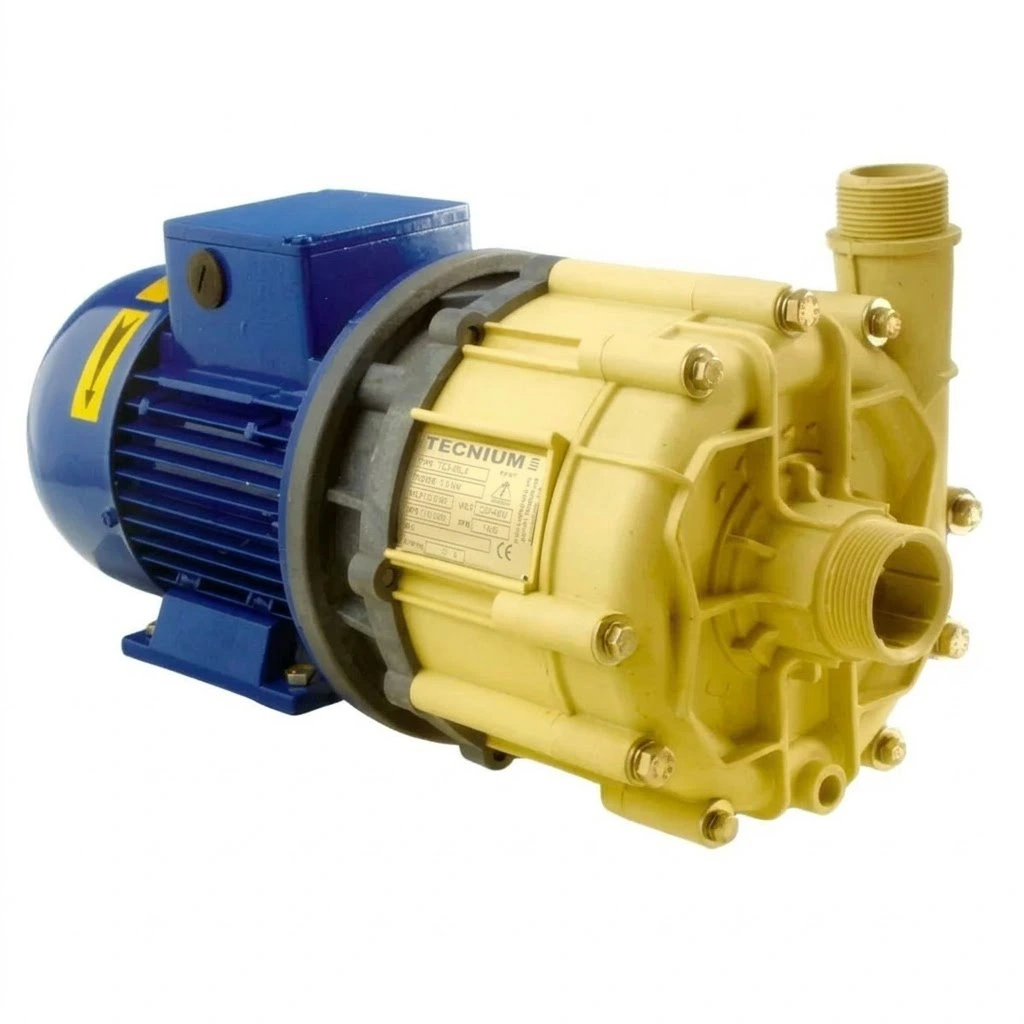
In the Tecnium Pumps range of plastic pumps, the seal is configured using exactly these criteria. BN process pumps, built to ISO 2858 / EN 22858, and BV process pumps accept single, double external and double internal mechanical seals, with a design that allows the seal to be removed without disconnecting the pump from the pipework. On BX series monobloc motor pumps and BH series close-coupled motor pumps, the available configurations include:
| Code | Configuration | Indicative application |
|---|---|---|
| SF | External single seal with bellows | Corrosive fluids: the product does not touch the metal parts of the seal |
| DE | Double external mechanical seal | High-risk fluids |
| IP | Internal single seal, SiC / SiC faces | Fluids with particles or demanding wear conditions |
| IF | Internal single seal, PTFE / ceramic faces | Very aggressive, clean fluids |
In addition, the seal seat is mounted free of strain on the plastic casing, a seal cover prevents any splashing of corrosive product, and replacing the seal does not require changing the impeller, whose clearances and geometry we explain in our guide to pump impeller types.
In some applications the best decision is not to have a mechanical seal at all. BKM series magnetic drive pumps transmit torque through a hermetic containment shell and guarantee zero leakage with toxic or volatile products, which are common in the chemical and pharmaceutical industries. BT series vertical sump pumps, BV series vertical pumps with hydrodynamic sealing and BHS series vertical motor pumps with their overflow design also do away with the seal and can run dry.
Mechanical seals: frequently asked questions
What is a mechanical seal?
What is the difference between a single and a double mechanical seal?
What are the advantages of a cartridge seal?
Why is silicon carbide used in mechanical seals?
What is a bellows seal and when should you use one?
When is a sealless pump the better option?
Not sure which seal your pump needs? Send our technical team the fluid and its concentration, the maximum temperature, the suction and discharge pressures, whether there are solids or a tendency to crystallise, and whether the installation is in an ATEX zone. We will propose the right pump, seal and face and elastomer materials. Request your free quote.
continue reading